Read More
2026-08-02 5 mins read
1PL, 2PL, 3PL, 4PL, 5PL: The Logistics Tiers Explained and Where the Importer of Record Fits
Read More

Latest
Custom Clearance
In global logistics, few words carry more weight than “Customs Clearance Completed.” This status represents the successful conclusion of customs checks, verification of documents, and settlement of duties and taxes.
More importantly, it signals that your shipment is no longer at risk of costly delays, unexpected penalties, or regulatory setbacks. At this stage, goods have officially met all compliance requirements and are cleared to move freely across the border.
For businesses engaged in cross-border trade, this milestone is more than just a formality—it is the gateway to certainty. Once achieved, it ensures that cargo can transition from customs control to delivery, giving importers, exporters, and e-commerce companies confidence in the smooth continuation of their supply chain. For companies shipping without a local legal entity, importer of record services ensure every compliance requirement is met before this milestone is ever reached.
The phrase customs clearance refers to the process of preparing and submitting documents, paying duties and taxes, and ensuring compliance with all trade regulations. It’s the stage where customs authorities decide whether a shipment can legally enter or leave a country.
When you see the status “customs clearance completed” (or customs cleared), it means your shipment has successfully passed all checks and is now authorized for release. At this point, goods can move out of customs control and continue toward the final delivery.
Document checks – invoices, packing lists, permits, and licenses.
Duties & taxes – confirmed and paid in full.
Inspections – compliance, safety, and regulatory verification.
Release – shipment cleared to move forward.
Document | Purpose |
|---|---|
Commercial Invoice | Declares the value of goods and transaction details |
Packing List | Confirms shipment contents, quantity, and weight |
HS Code | Classifies products to determine tariffs and regulations (Customs entry requires the full national tariff code, not just the global HS — understanding the HS vs HTS code differences is the difference between a 24-hour clearance and a multi-week hold.) |
For temporary import or repair-and-return shipments, customs requires the RMA number on the commercial invoice to confirm the goods are not a new commercial sale — without it, full duty is charged on entry.
At the border, every shipment faces a moment of uncertainty. Customs officials review documents, calculate duties, and confirm compliance. Until these checks are complete, goods remain on hold. Clearance removes that uncertainty—protecting shipments from delays, penalties, or even seizure.
EXAMPLE
High-value technology such as servers and networking gear often undergoes additional scrutiny to meet standards like CE (EU), FCC (USA), or CCC (China) before being released.
Regulatory compliance – ensures shipments meet trade, tax, and safety laws
Revenue collection – allows governments to assess and collect duties
Consumer protection – keeps sensitive goods like tech and medical devices safe and compliant
Clearance times vary by country, product type, and documentation quality. Well-prepared shipments move quickly, while errors or compliance issues can result in a shipment held at customs — causing costly delays and regulatory setbacks.
EXAMPLE
Shipping pharmaceuticals from India to the EU usually takes longer because of strict regulatory checks (EMA approvals, safety testing), while sending consumer electronics from Japan to the EU often clears more quickly since they already meet CE standards.
Origin/destination regulations: – stricter countries enforce longer review times
Type of goods: – regulated or restricted items (e.g., tech, medical, chemicals) require more checks
Documentation accuracy: missing or incorrect paperwork causes delays
Seasonal peaks: holidays or trade surges increase processing time
Random inspections/security flags: shipments may be held for extra screening
The amount you pay at customs depends on several factors, including the HS code classification, the destination country's regulations, and the declared value of the goods — all of which directly affect import duty rates and calculations. These charges are mandatory and must be settled before your shipment is released.
Customs duty (tariff) – based on HS code and product origin
Import VAT/GST – value-added tax applied on imports
Excise tax – applied to goods like energy, telecom, alcohol, or tobacco
Environmental fees – including EPR, WEEE, and packaging taxes in certain regions
Download Global Customs Duties & Taxes Quick Guide
Avoid costly surprises at the border. Get our free PDF for a quick overview of duties, VAT, and other import charges worldwide.
Even with proper planning, shipments can encounter delays at customs. The most frequent challenges include:
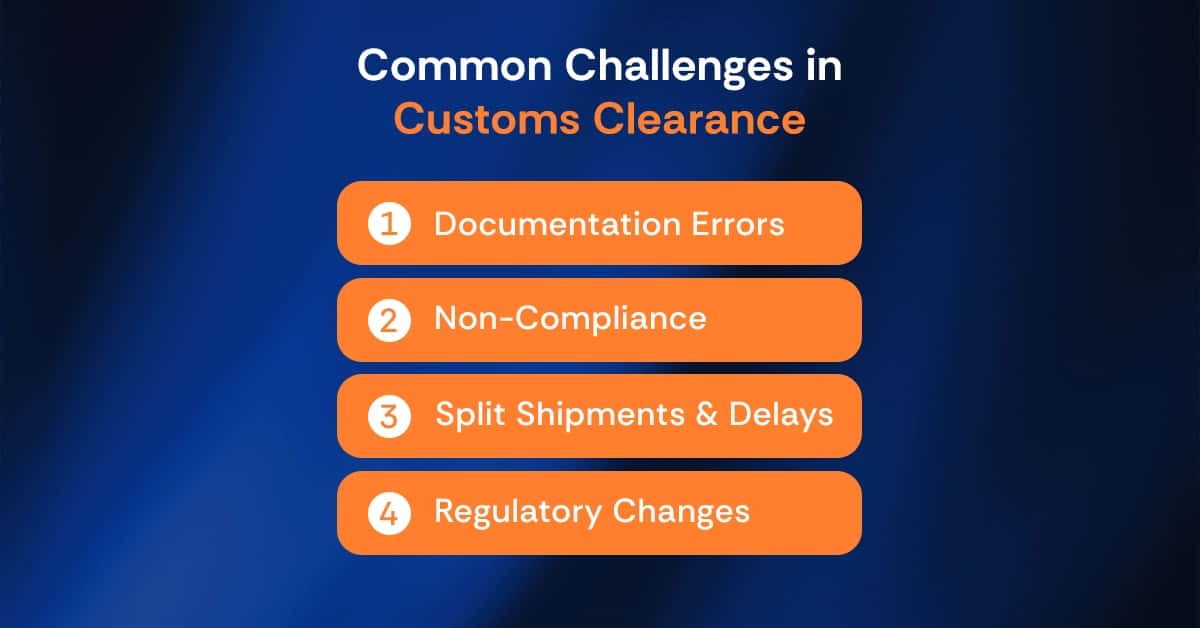
Documentation errors – mismatched invoices, incomplete forms, or missing HS codes
Non-compliance – absence of required certifications such as CCC (China), BIS (India), or CE (EU)
Split shipments & freight delays – consolidated cargo can be held up if one part of the shipment is flagged
Regulatory changes – sudden tariff increases, new sanctions, or updated trade rules
Once customs clearance is completed, the shipment’s story continues through four key stages:
Clearance – After days of uncertainty, customs gives the green light. All documents match, duties are paid, and compliance is confirmed. The cargo is now officially free to move.
Release – The shipment leaves the grip of customs control. For some, this means exiting a bonded warehouse; for others, it’s a direct handoff for transport. Either way, the goods are no longer held back.
Tech imports are among the most regulated in global trade. Servers, telecom gear, lithium batteries, and medical devices often trigger extra checks for encryption controls, dual-use restrictions, and safety compliance — all part of what trade compliance requires for high-value tech shipments. These requirements go beyond normal customs paperwork and can be the main reason shipments are delayed at the border.
Tech Compliance Requirements by Region
Region | Authority / Certification | Typical Requirement |
|---|---|---|
USA | BIS/FCC | Encryption controls; telecom & wireless approvals |
For global businesses, customs clearance is often the biggest barrier to smooth shipping. From hidden duties to strict certifications, a single mistake can stall your supply chain. IOR/EOR removes these obstacles by managing every critical step of the process, including:
Acting as Importer of Record – taking legal responsibility for your shipment in the destination country
Handling duties & VAT – ensuring taxes are paid accurately and on time
Ensuring compliance – securing certifications like CCC (China), BIS (India), CE/FCC (EU/USA)
Providing landed cost calculations – giving full visibility of total import expenses before shipping
Guaranteeing faster, compliant delivery – minimizing delays and avoiding costly errors
In international trade, time is money—and customs clearance decides whether you save it or lose it. Every delay adds cost, stress, and risk.
With IOR/EOR, your shipments move forward without friction. We handle the regulations, duties, and paperwork so you can focus on your business.
Write a better ending for your shipments—contact us today.
No. Many shipments are risk-screened electronically and released without a physical exam. Customs may select packages for document review, X-ray, or inspection based on risk profiles, value, commodity, or random sampling.
Typically, 1–7 days if documents and duties are in order. It can extend to weeks if the shipment is flagged for inspection, missing paperwork, unpaid duties, or special certifications.
Depends on the Incoterms and contract. Under DDP, the seller/shipper covers duties & taxes; under DAP/DDU, the importer/consignee pays at destination. If using an IOR, they may pay on the importer’s behalf.
The shipment is held until issues are resolved (correct documents, certifications, and payments). In severe cases, goods may be returned to origin or seized. Storage/demurrage costs can accrue during holds.

Creative Marketing Director specializing in the operational side of global trade. He writes about compliance documentation, clearance and import processes, industry and regulatory updates, and the day-to-day logistics that keep shipments moving, turning dense procedural detail into guidance teams can actually act on.

Certificate of Origin | Verifies the country where the goods were manufactured |
Import/Export License | Mandatory for restricted or regulated goods |
Bill of Lading / AWB | Serves as proof of the shipping contract and transport details |
Power of Attorney | Authorizes a third-party IOR or broker to file customs declarations on behalf of the importer — see power of attorney for international shipping for requirements by country |
Delivery – Responsibility shifts to the consignee or logistics partner. Trucks, couriers, or freight services are scheduled, ensuring the cargo makes its final journey without disruption.
Customer – The shipment reaches its destination. Whether it’s critical IT equipment, telecom gear, or medical devices, the goods are finally in the hands of the customer who was waiting for them.
India | BIS | Certification for electronics and IT hardware |
EU | CE/ADR | CE marking for electronics; ADR compliance for lithium batteries |
Brazil | ANATEL | Approval for telecom and wireless devices |
China | CCC | China Compulsory Certification for IT and telecom equipment |
Middle East (UAE, KSA) | TRA / CITC | Approval for telecom, wireless, and encryption-enabled devices |