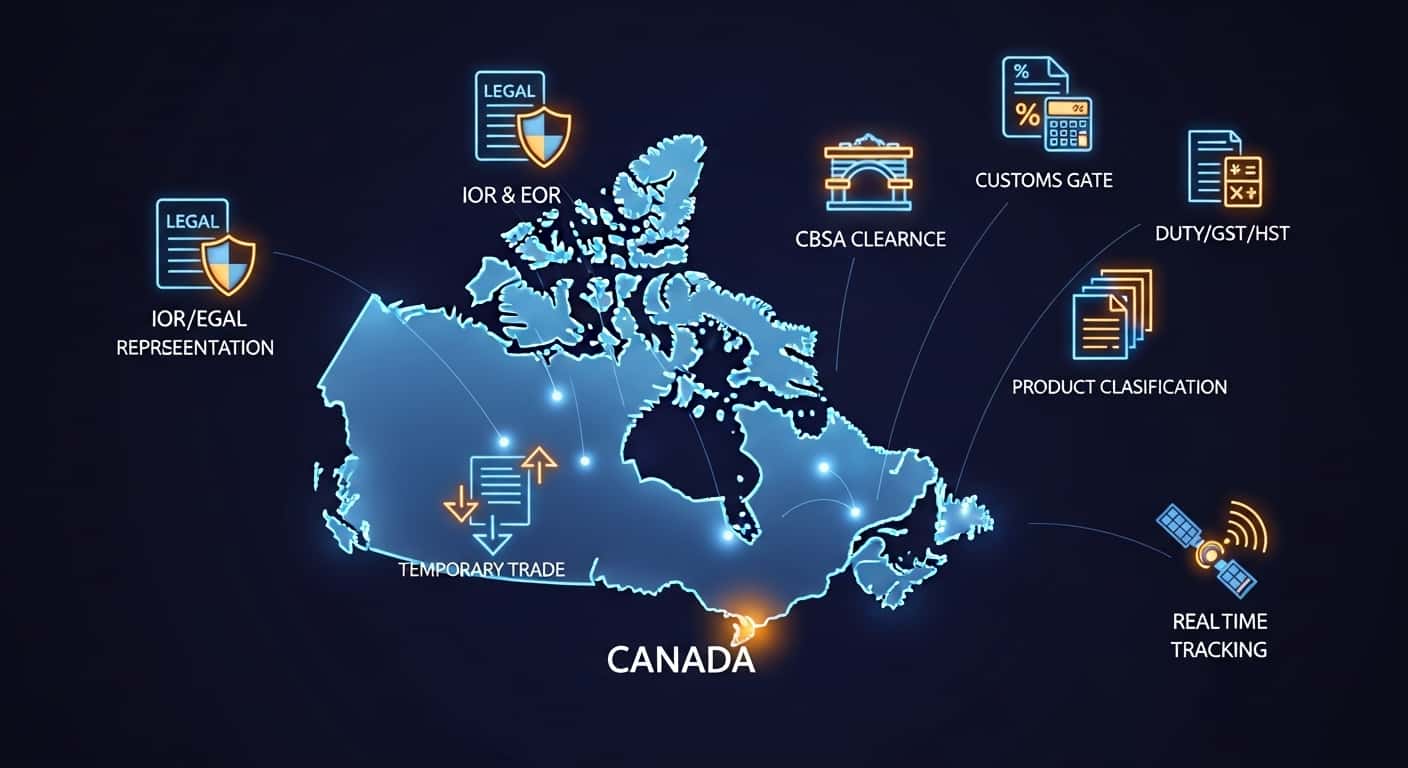
Canadian customs is one of the most regulated in the world, governed by CBSA clearance rules, GST/HST tax frameworks, and strict product oversight from Health Canada and ISED. For businesses moving high-value IT, telecom, or medical equipment, these complexities can translate into costly delays, unexpected duties, or compliance risks
In Canada, the IOR ensures compliant imports, while the EOR manages exports—together they safeguard your business against delays, penalties, and compliance risks.
Acting as your legal IOR/EOR and maintaining records.
Managing customs clearance and documentation
Calculating and remitting duties, GST/HST.
HS code classification and tariff alignment.
Securing permits and approvals for regulated goods.
Ensuring compliance records and audit readiness.
Indicator | Details |
|---|---|
GST/HST | 5–15% depending on province (e.g., 13% ON; 14% NS from Apr 1, 2025; 15% NB/NL/PE; 5% GST in non-participating provinces) |
Import Duties | 0–18%+ depending on HS code and origin |
Clearance Time | Same day to 3–5 business days if documentation is complete |
Financial Security (RPP) | Importers must post security in CARM to obtain Release Prior to Payment |
Top Import Sectors | IT, Telecom, Medical Devices, Aviation |
If any of the following apply, using an IOR/EOR avoids delays and liability:
You don’t have a Canadian legal entity (NRI model required).
You’re importing regulated goods (medical devices, NHPs, wireless/telecom).
You’re handling RMAs/returns or temporary imports.
You need cost optimization on duty/GST/HST and proper HS classification.
You want to prevent CBSA post-accounting issues or audits.
Sector | Needs & Our Support |
|---|---|
IT & Telecom | HS classification; ISED/RSS compliance & radio approvals; shipment documentation; DDP delivery. |
Medical Devices | Import under a valid MDEL (if required); MDL coordination with manufacturers; labeling & records. |
Natural Health Products (NHPs) | NPN licensing path, GMP evidence, labeling verification. |
Aviation | HS classification for parts; expedited CBSA clearance; export controls support when applicable (ECL). |
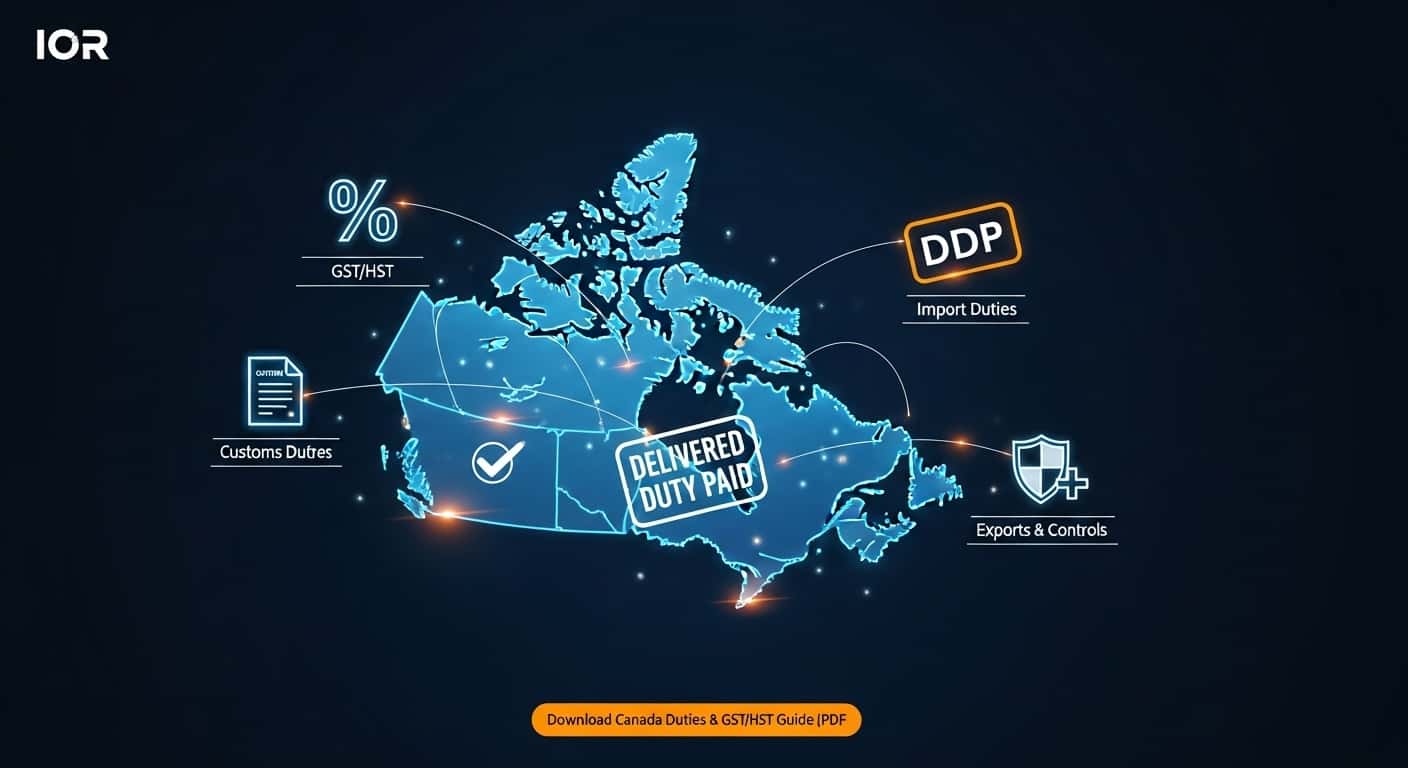
Importing into Canada means managing province-based taxes, duties, and export controls. Key compliance steps include:

GST/HST
Rates range from 5–15% depending on the province. Use the CRA’s official rates and calculator for accurate estimates.
Import Duties
Based on HS code and origin, with FTA preferential rates where applicable.
Delivered Duty Paid (DDP)
Duties and taxes consolidated upfront for a clear “landed cost.”
Exports & Controls
Certain goods need permits under the Export Control List (ECL).
Enter your email to receive the PDF download link.

Acting as your local legal importer/exporter (IOR/EOR).
CBSA customs clearance & accounting.
Duty/GST/HST calculation and payment workflows.
Product classification & permits (MDEL, NPN, ISED).
Temporary imports and re-exports.
Real-time tracking and proactive compliance updates.
Expertise in IT, medical, and NHP compliance.
We act as your legal IOR in Canada.
One partner for compliant imports and exports.
HS coding, GST/HST, and cost-saving rules.
Compliance updates and shipment tracking at every step

Ensure your shipments clear Canadian borders smoothly and compliantly—with no delays, hidden costs, or compliance risks. Partner with IOR/EOR and gain a trusted Importer & Exporter of Record for IT, telecom, and healthcare logistics across Canada.
The IOR ensures customs, tax, and compliance requirements are met, acting as the legal entity responsible for the shipment.
They assume full legal responsibility for export compliance, including licenses, declarations, and documentation.
Yes. Even non–dual-use goods require IOR/EOR when you lack a local entity or need in-country compliance representation.
Pricing depends on destination, product type, and regulatory complexity. Costs cover compliance, duties, and representation, helping avoid delays and penalties.
The best way is to partner with a trusted Exporter of Record like IOR/EOR, which manages compliance, licensing, and documentation from the start — reducing risks of delays, penalties, or seized shipments.