Read More
2026-08-02 5 mins read
1PL, 2PL, 3PL, 4PL, 5PL: The Logistics Tiers Explained and Where the Importer of Record Fits
Read More

Exporter of Record
What if your company ships high-value servers overseas? Everything is on schedule—until customs halts the shipment. A missing export license. An overlooked document. Suddenly, what should have been a smooth departure turns into weeks of delay, unexpected fines, or even the risk of losing your equipment altogether.
Scenarios like this aren’t rare; they happen every day in global trade. That’s why the legal exporter representation exists. Far more than paperwork, the EOR acts as the legally responsible entity that ensures your goods leave their country of origin in full compliance with all applicable regulations, licenses, and documents.
For businesses without a local entity or export expertise, partnering with an EOR is the difference between stalled shipments and seamless trade. In simple terms, the Importer of Record (IOR) safeguards the inbound journey, while the Exporter of Record (EOR) protects the outbound side, two essential roles that keep international commerce moving smoothly and compliantly
Export regulations may be complex, but with the right EOR in place, every shipment leaves with security, speed, and peace of mind.
An Exporter of Record (EOR) is the authorized person or legal entity responsible for ensuring that goods are exported in full compliance with the origin country’s laws and regulations. The EOR assumes legal liability for the accuracy of documentation, adherence to export control laws, and proper record-keeping throughout the transaction — including the management of DDP responsibilities when the seller is obligated to cover all duties, taxes, and import costs at the destination.
Classify goods correctly under ECCN and HS codes
Obtain export licenses & permits where required
Prepare and submit documentation for customs clearance
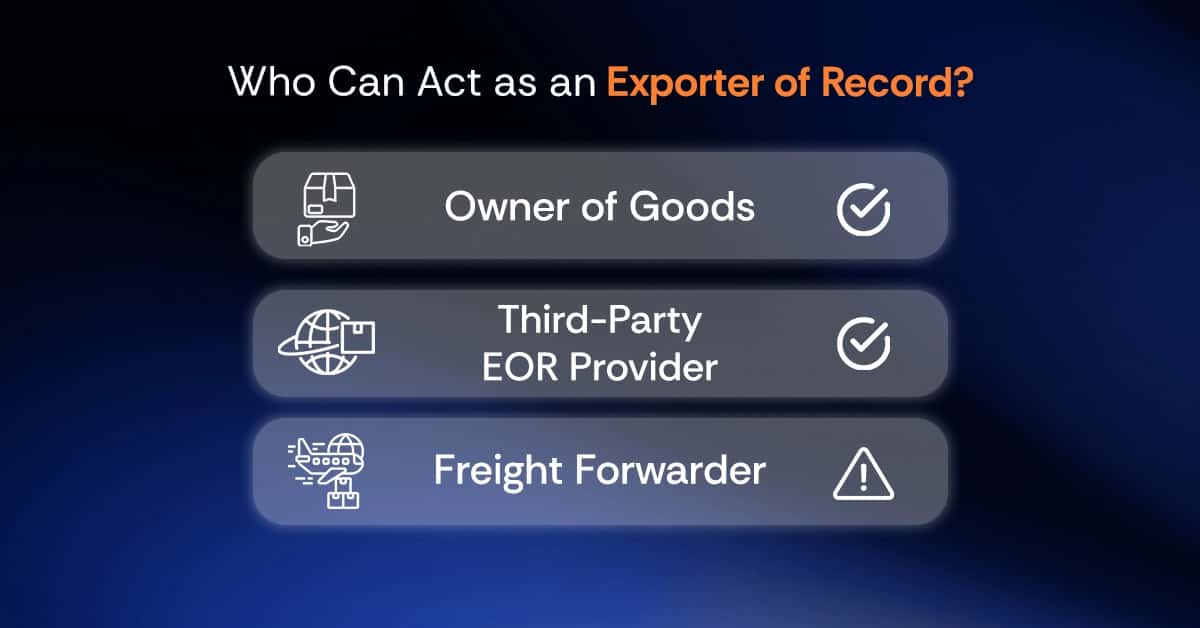
Not every party involved in an export transaction is qualified—or willing—to serve as the Exporter of Record (EOR). The role requires legal authority, compliance expertise, and the ability to assume liability for the export. The table below outlines the most common scenarios:
Entity | Can They Be EOR? | When/Why | Limitations |
|---|---|---|---|
Owner of Goods (Shipper/Manufacturer) | Yes | Default EOR if legally registered in the country of export. | Must have local entity and compliance expertise. |
An Exporter of Record differs from a freight forwarder and other logistics providers in the party logistics tiers by carrying the legal export responsibility that logistics providers do not automatically assume
Behind every smooth export is someone ensuring the rules are followed. The Exporter of Record (EOR) is that guardian—turning complex regulations into a checklist that keeps shipments moving. Their role includes:
Classify goods correctly: under the correct HS and ECCN codes as required by export control laws.
Obtain export licenses & permits: where products are restricted, controlled, or dual-use.
File export declarations: where legally required, such as EEI via AES for qualifying U.S. shipments.
Declare shipment details truthfully: including value, description, and end-use—where disclosure is mandated.
Maintain compliance records: where regulations apply, typically for 5+ years in jurisdictions like the U.S. and EU.
Many global businesses rely on professional EOR partners when exporting IT equipment, medical devices, or other regulated goods. By outsourcing the role, they avoid compliance risks, keep shipments on schedule, and free up resources to focus on growth.
An Exporter of Record (EOR) becomes essential when your company faces compliance or operational gaps in the export process. Typical scenarios include:
If your business has no legal presence in the country of export, you’ll need an EOR to act on your behalf.
Shipments involving IT equipment with encryption, medical devices, or aviation parts often require an EOR due to strict export controls.
For dual-use or sensitive items, an EOR helps secure the correct export licenses and ensures compliance.
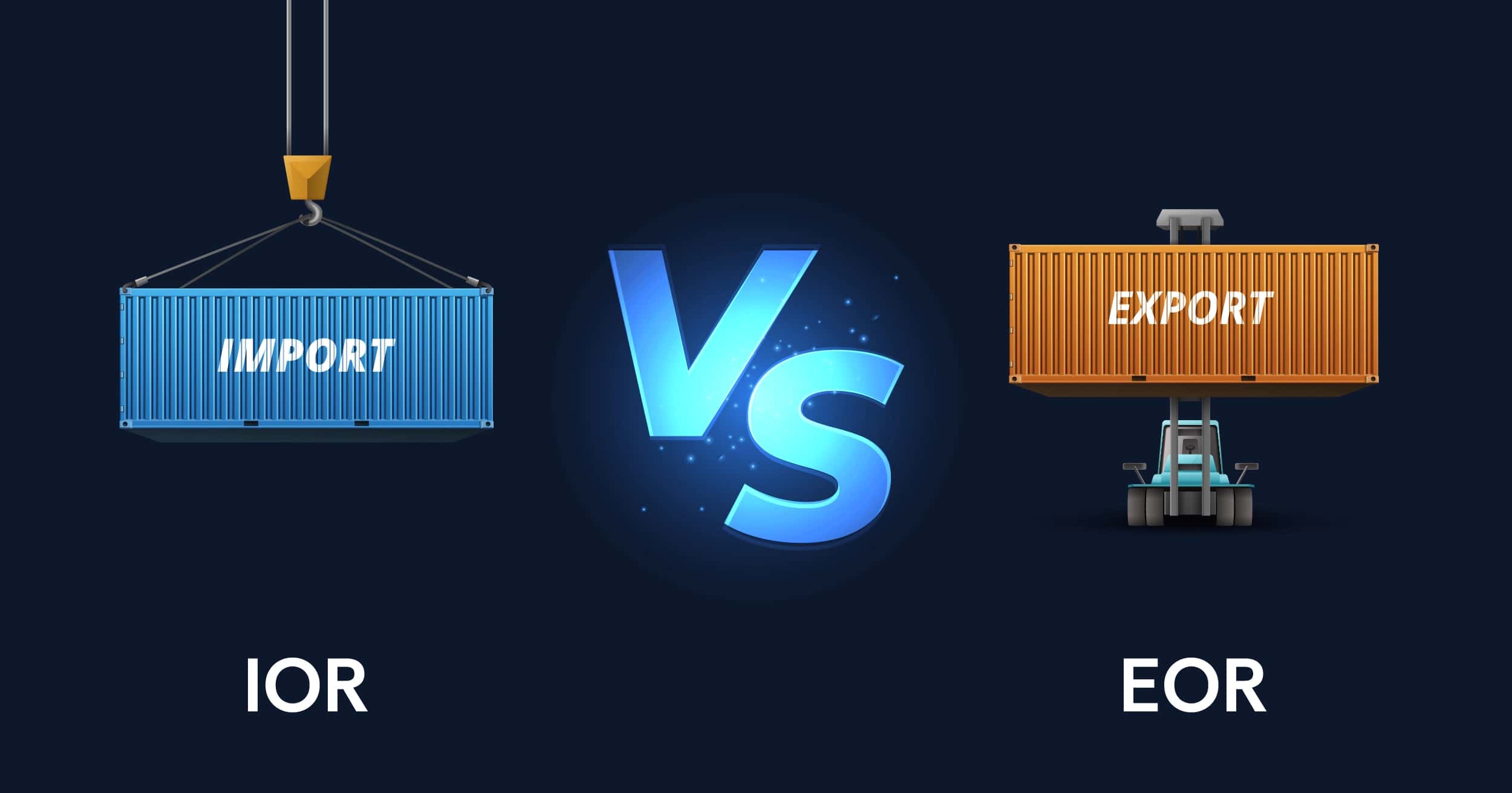
EOR and IOR are the twin anchors of cross-border trade. The EOR ensures shipments leave a country in compliance, while the importer of record services ensures they arrive legally at their destination. Together, they complete the compliance journey.
Role | EOR (Exporter of Record) | IOR (Importer of Record) |
|---|---|---|
Responsibility | Outbound compliance (goods leaving the country) | Inbound compliance (goods entering the country) |
Duties | Export licenses, EEI filings, ECCN classification | Import duties, tariffs, VAT, and taxes |
Freight forwarders can always act as EOR.
In reality, most forwarders avoid this role—they rarely hold the licenses or take on the liability required.
EOR just means the shipper.
Not true. The Exporter of Record is a legal designation tied to compliance, not simply the party sending goods.
Any party can handle exports informally.
Using unqualified exporters risks fines, shipment seizures, or blacklisting with authorities.
A professional EOR is your fast lane through customs, your shield against compliance risks, and your partner for smooth global trade—so you can focus on growth, not paperwork.
Seamless customs clearance
Strict regulatory compliance
Minimized risks & delays
Global trade expertise
More time for growth
Every export tells two stories: the journey of goods and the journey of compliance. The Exporter of Record (EOR) ensures both align—acting as the legal guardian of outbound trade. Unlike shippers or freight forwarders, the EOR assumes full responsibility for licenses, filings, and regulations, turning complex requirements into seamless departures.
IOR/EOR delivers trusted Exporter of Record services in 170+ countries—let us be the partner that keeps your global trade moving.
The Exporter of Record (EOR) can be the owner of the goods, the shipper/manufacturer (if legally registered in the export country), or a licensed third-party EOR provider. Freight forwarders rarely act as EOR since most avoid the legal liability.
No. While a shipper arranges the physical movement of goods, the EOR is a legal designation responsible for export compliance, licensing, and documentation. A shipper may also be the EOR, but not always.
An EOR is required because governments demand a legally accountable entity to ensure goods are exported in line with all laws and regulations. Without an EOR, shipments risk delays, fines, seizures, or loss of export privileges.

Declare shipment value & contents accurately
Maintain compliance records for audits and inspections
Third-Party EOR Service Provider | Yes | Common choice when businesses lack a local entity or export knowledge. | Service fees apply; must rely on provider’s compliance scope. |
Freight Forwarder | Rarely | May act in limited cases if properly licensed and willing to assume liability. | Most avoid EOR responsibility due to risk and lack of licenses. |
Accept legal responsibility: where penalties, sanctions, or enforcement actions result from non-complianc
Partnering with an EOR helps avoid penalties, shipment holds, and costly delays at the border.
Goods sent back for managing international RMA returns, repairs, or end-of-life replacement may need EOR oversight to clear out of the country properly.
Legal Scope | Governed by export country regulations | Governed by export country regulations |
Risk | Export violations, sanctions, loss of export rights | Customs delays, fines, penalties, and shipment holds |