Read More
2026-08-02 5 mins read
1PL, 2PL, 3PL, 4PL, 5PL: The Logistics Tiers Explained and Where the Importer of Record Fits
Read More

Custom Clearance
There was a time when global trade relied on intuition and ink stamps — brokers armed with binders and checklists, chasing approvals that crossed continents at the speed of paper. That era is fading fast. Today, a new kind of intelligence is entering the customs gate — one that reads, predicts, and decides faster than any manual process ever could. Artificial intelligence isn’t just a tool; it’s a quiet revolution in motion.
With 45 % of customs authorities planning to deploy AI systems by 2025 (VAO World Benchmark), the question isn’t if borders will go digital — it’s how fast they’ll learn to think.
Customs has always been documentation-heavy and time-sensitive, yet its architecture remains largely manual. Human oversight adds control — but also bottlenecks.
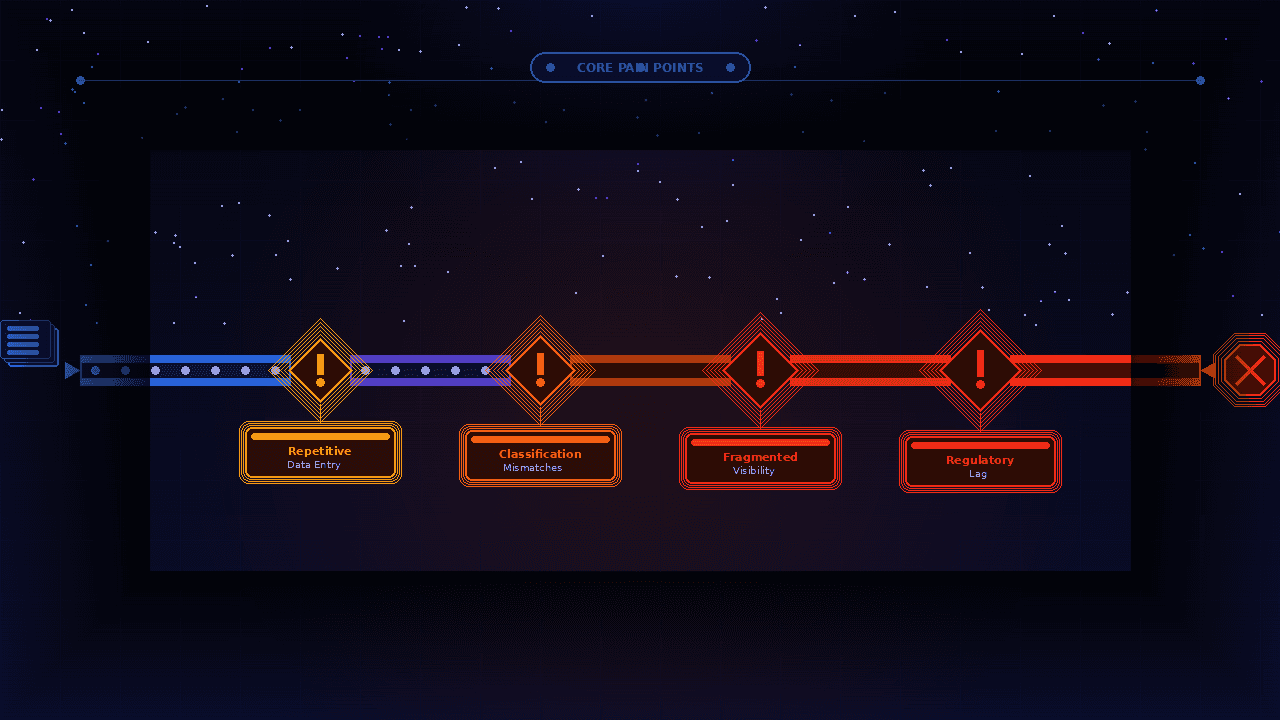
Repetitive data entry across multiple declarations and agencies
Classification or valuation mismatches triggering holds
Fragmented visibility between supply-chain actor
Limited ability to react to new regulations in real time
Note: Manual clearance averages 3–7 days with ~70 % accuracy, while AI-assisted processes achieve 4–8 hours and 95 % accuracy (VAO World 2025)
AI brings structure to data chaos. It can read, interpret, and act at speeds that reshape the entire clearance cycle.
AI Capability | Function | Result |
|---|---|---|
Optical Character Recognition (OCR) | Converts scanned invoices, COO, and packing lists into machine-readable data | Eliminates manual data entry |
Natural Language Processing (NLP) |
Note: According to the VAO World 2025 Report, AI can cut documentation time by 67% and reduce clerical errors by 80%. When properly trained on trade data, these models don’t just process information — they learn compliance behavior.
For logistics experts and compliance leaders, AI turns border management from a reactive obligation into a proactive advantage, delivering measurable gains across every stage of trade execution. The following highlights its most impactful benefits:
Speed & Reliability: Predictive filing and automated validation reduce clearance time from days to hours, eliminating demurrage and minimizing manual delays.
Regulatory Accuracy: Intelligent cross-checking between tariff codes, trade databases, and licensing systems ensures declarations meet every regulatory standard — complementing structured export compliance solutions that provide the legal export representation AI alone cannot replace.
Cost Efficiency: Automation cuts administrative overhead, minimizes costly errors, and optimizes working capital through faster inventory turnover.
As AI reshapes customs processes worldwide, regulatory bodies are not standing still — they’re redesigning the very frameworks that govern trade. From advanced pilot programs to policy-driven digital borders, global adoption is accelerating across key regions:
Under the UCC reform, the EU is creating a centralised “EU Customs Data Hub” and a new Customs Authority — designed to support automated risk-analysis across Member States using advanced analytics
CBP employs AI and machine learning to analyze cargo data and flag high-risk shipments before arrival, improving inspection accuracy and national security efficiency.
Despite its advantages, adopting AI in customs is rarely straightforward. Most hurdles stem from data quality, legacy systems, and workforce adaptation. The following highlights key challenges and how leading organizations overcome them:
Challenge | Risk | Mitigation Strategy |
|---|---|---|
Data Quality Issues | Inaccurate inputs reduce AI reliability. | Enforce data governance and continuous cleaning pipelines. |
Integration Complexity |
AI doesn’t just accelerate customs processes — it reinforces the integrity behind every clearance. By combining automation, data analytics, and continuous monitoring, it turns compliance from a reactive task into a predictive safeguard.
1. Automated Screening
Instantly checks entities and transactions against restricted and denied-party lists.
2. Smart Classification
Uses pattern learning to assign HS codes accurately, minimizing valuation and tariff errors.
3. Continuous Audit Trail
As global trade becomes increasingly data-driven, the next evolution of customs clearance will rely on intelligent ecosystems rather than isolated automation tools. — extending beyond the border into how AI improves returns and reverse logistics flows that are just as compliance-critical as forward shipments. The future of AI in customs lies in systems that learn, predict, and act autonomously — shifting compliance from a managed process to a self-adaptive intelligence that safeguards every transaction.
This is not a distant vision — it’s the direction global regulators, logistics providers, and compliance partners are already taking. Companies that invest in AI readiness today will define tomorrow’s trade efficiency.
At IOR EOR, we don’t use or develop AI technology — our strength lies in human-led compliance expertise supported by proven processes and global experience. While AI is transforming the industry, our focus remains on precision, transparency, and regulatory integrity — the values that keep every shipment fully compliant and on time.
AI automates the processing, classification, and risk analysis of customs documents to accelerate clearance and reduce errors.
By validating data and screening transactions in real time, AI ensures every entry aligns with current trade laws and regulations.
Yes. Modern systems employ encryption, blockchain verification, and access-control protocols to safeguard trade data.
No. It enhances their roles by automating repetitive work and enabling focus on strategic compliance decisions.
Predictive, connected, and transparent customs systems — built on the foundations of AI, IoT, and blockchain — that make global trade faster, smarter, and fully compliant.


Extracts meaning from unstructured declarations |
Flags inconsistencies before filing |
Machine Learning Classification | Learns HS/HTS patterns from prior shipments | Reduces tariff misclassification |
Predictive Analytics | Anticipates risk, congestion, or inspection probability | Enables proactive pre-clearance |
Conversational AI Assistants | Handle client and authority queries 24/7 | Deliver real-time transparency |
Predictive Visibility: AI-driven alerts flag potential inspections, duty revisions, or port congestion — allowing proactive scheduling and uninterrupted delivery flows.
Scalability: Adaptive AI systems handle peak seasons and expanded product portfolios without additional staff or infrastructure strain.
The National Trade Platform applies AI to streamline declaration handling and documentation review— cutting processing time by nearly half while maintaining full regulatory traceability.
Through its Smart Borders 2025 initiative, the WCO promotes the adoption of AI, IoT, and blockchain for transparent, data-driven customs ecosystems.
Legacy systems limit AI compatibility. |
Use API or middleware bridges for seamless integration. |
Cybersecurity Concerns | Sensitive trade data may be exposed. | Apply end-to-end encryption and strict access controls. |
Change Resistance | Staff hesitate to trust automation. | Provide training and redefine roles as “AI validators.” |
Maintains full traceability for regulatory reviews and internal audits. This capability works hand in hand with IOR compliance solutions to ensure every import transaction is documented, legally defensible, and inspection-ready.
4. Proactive Alerts
Notifies stakeholders when tariff updates or license expirations occur, preventing costly oversights.